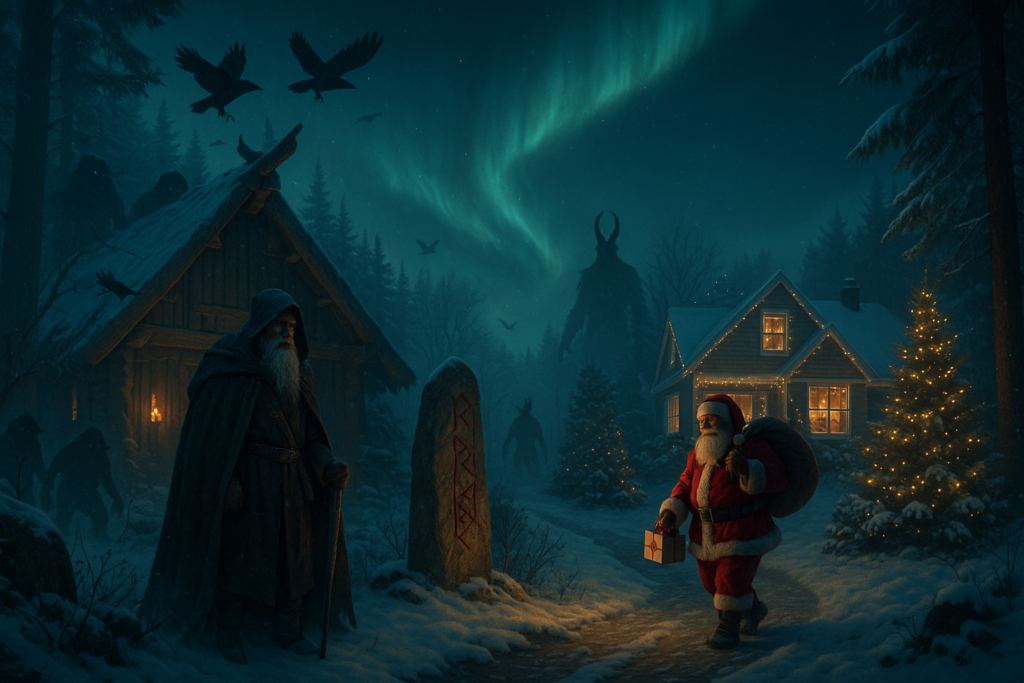
The movie Red One on Amazon feels like a door quietly swung back to the oldest winter road, before candles and carols, back when the year died roaring in the dark and the people answered with fire. It remembers what the season was in the Germanic and Scandinavian nights: Yule, not as decoration, but as a truce between the living and the things that hunt the edges of the world.
In those first winters, Yule belonged to wandering gods and hungry shadows. Odin in his cloak rode the storm sky as Jolnir, visiting halls in the deep night to weigh courage and cowardice. From those cold visitations grew a tangle of names that still echo in our stories: Cinder Klaus, the soot marked spirit of the hearth who slipped down chimneys, Saint Nicholas and Chris Kringle stepping out of the same northern mist, and beside them the darker companions like Krampus, horned and wild, who carried the memory that some lessons arrive with chains instead of ribbons. Around the firelight lurked trolls, the teeth of the mountains given crude bodies, and in the far reaches of the snow walked the winter witch, that stern keeper of the dead season who judged whether the work of the year was honestly done. In the deep North they also whispered of Gryla, the mountain hag who came down at Yule to scoop up cruel and careless children, proof that the season’s generosity always walked with a shadow close behind.
As the centuries turned, those figures did not vanish, they learned to wear new clothes. Families carried their Yule fires forward under Christian calendars, folding old rites into new prayers. Evergreen branches that once promised the forest would wake again became Christmas trees. Offerings to house spirits turned into cookies left out for Santa, and the threat of Krampus thinned into the simple idea of coal for the cruel and kindness for the kind. Grandmothers told stories of “the Red One” with a glint in the eye that belonged to older gods, and parents taught their children to light candles, hang stockings, and keep certain little customs without ever naming the pagan bones beneath them. The faith at the surface changed, but under it the same river moved quietly on, carrying Yule from hearth to hearth under a different sky.
Each passing age added its own ornaments to that river. The Victorians wrapped it in paper and ink, giving us ghost stories by lamplight and the soft moral gravity of Dickens. Immigrant families braided their old country customs into new world streets, turning city tenements into little pockets of remembered homeland. In the last century, an advertising painter brushed our winter guest into a bright red suit on a soda poster, and that single image walked the globe faster than any wandering god ever could. Radios taught the world to sing the same songs, black and white screens turned snowbound villages into stages, and storefront windows became shrines to a jolly, round figure everyone recognized without needing his name. Yet beneath the glass and neon, it was still the same ancient bargain: light the dark, share what you have, and hold one another through the longest night.
What I love is that all of this can live comfortably beside the Christmas many people cherish. The film does not argue with nativity scenes or church bells. It simply reaches deeper into the roots and reminds us that long before there were carols, people stood shoulder to shoulder in the cold and chose to kindle light. Call it Yule, call it Christmas, call it by whatever name your heart knows. Under every title the season is still this: we gather in the dark, we face the long night together, and we answer winter with courage, kindness, and a little stubborn magic. That, to me, is the real reason for the season, and Red One just lets the older snow show through the fresh fallen layer.
“Tradition is not the worship of ashes, but the preservation of fire.” –
Gustav Mahler
Leave a Reply
You must be logged in to post a comment.