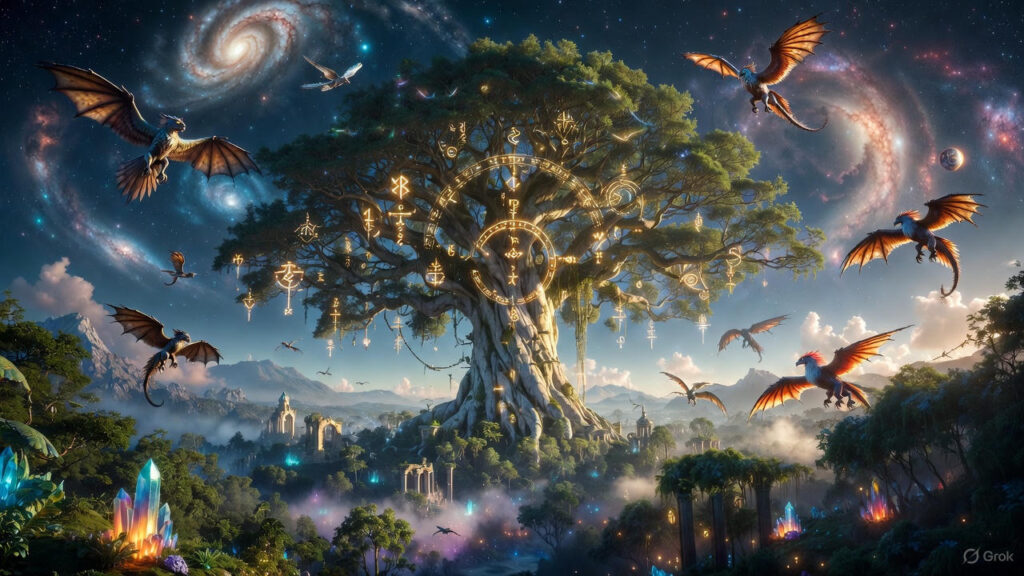
My research began in late 2023. I had started writing a short story drawn from the final years of my twenty-two-year career as a police officer—a raw account of my battle with complex PTSD. That struggle had driven me to question the very essence of life: its purpose, its origins, and why existence unfolded as it did.
What began as a path of self-discovery plunged me into a labyrinth of myth, legend, and religion. From there, it spiraled into science and quantum physics—the gods, the cosmic tree, the wolves. I know others have woven tales like this before, but none inspired me more than Neil Gaiman. His masterful blend of ancient lore with modern shadows shaped my writing in ways no other author could.
The short story found its way to Kindle Direct Publishing as an eBook, marking my debut as an author. It performed remarkably, climbing to number one in all its categories and even cracking the Kindle top 1000 for a fleeting moment—a feat far grander than it might seem, given its current perch somewhere in the 300K range. You can discover the book, my blog, and glimpses of my ongoing novel at jimdaleybooks.com.
As I sifted through the notes from that story, a pattern emerged, subtle yet insistent. It threaded through pantheons, echoed in cycles, and resurfaced across eras and cultures. Living with ADHD, I’m wired to spot even the faintest connections, but it also pulls me into hyperfocused rabbit holes when an idea takes hold. I drew inspiration from renowned scientists and quantum physicists, their theories sparking concepts I longed to test—but without the tools to do so.
What if it was all real, on some profound level?
Few dare to prove it, fearing ridicule as mad visionaries or backlash from entrenched religions. But those religions lack one crucial element: proof. They demand faith instead, a blind surrender to belief despite evidence to the contrary. For me, faith has always been a perilous notion, urging people to ignore instincts and embrace illusions. Millions have been conditioned to see this as virtue, even as it vilifies truth-tellers. In Judeo-Christian lore, Prometheus wasn’t hailed as a bearer of knowledge and fire but condemned as an enemy. Lucifer, the light-bringer, sought to reveal uncomfortable truths and was cast as a demon for it. We’ve erected cathedrals to ignorance, stifling scientific progress for centuries, perhaps millennia.
Faith isn’t noble. Your instincts exist for a reason, heed them. One tradition I’ve long admired is Buddhism, which often presents itself not as a religion but as a practice. Many of its teachings are verifiable, grounded in experience. As the Buddha wisely advised, “Do not believe something merely because I have said it is so. Investigate it for yourself.” That’s the mark of an honest guide. Yet even Buddhism couldn’t answer every question gnawing at me.
Then came a breakthrough: a tool capable of what I couldn’t achieve alone. It could transform my ideas and theories into rigorous mathematics. The advent of AI empowered dreamers like me to validate our visions through precise calculations.
Though I’m a solid coder with a firm grasp of object-oriented programming, higher math has never been my strength, it’s not even essential for coding. But the equations underpinning our universe demand a level of mathematical sophistication far beyond my reach. I knew this much: math could illuminate everything, existence itself, and the reasons behind its forms.
So, I dusted off my old notebook and collaborated with AI models to crunch the numbers. I fed them concepts, cross-referenced ideas, and watched as they debated theories, clashing over equations until coherence emerged. It was mesmerizing, like witnessing digital minds forge order from chaos. Agreements solidified across models, and from that seed of thought, Yggdrasil took root—a plausible framework for our very existence.
For the first time, I unveil the fruits of that descent: the results, the mathematics, and the blueprint to recreate this engine. I share it because these ideas transcend mere world-building for games or stories; they hold the power to illuminate our reality.
Here is the seed. Plant it, nurture your own tree, and uncover what you truly are. I’ll reveal more in my next novel, but you can seek it yourself, it’s woven into the world around you. Look for the patterns.
Albert Einstein once captured the essence of this kind of exploratory wonder: “The most beautiful thing we can experience is the mysterious. It is the source of all true art and science. He to whom this emotion is a stranger, who can no longer pause to wonder and stand rapt in awe, is as good as dead: his eyes are closed.”
Leave a Reply
You must be logged in to post a comment.